Calculating the placement of the Hip.
The idea is to place the hip so that the edges on both sides are the same height as the rest of the rafters where they cross the outside wall. For a single pitch hip (regular) the hip sits centered on the corner. This is not the case for a two pitch (irregular) hip. Just as it takes the lower pitch more run to reach the same height as the higher pitch, more of the hip should sit to the lower pitch side.
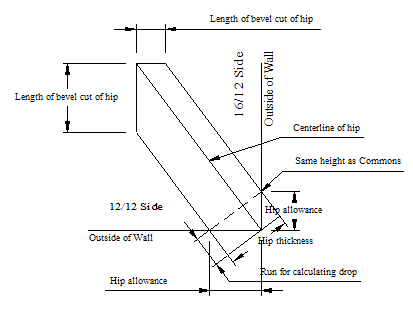
Example shows 12/12 on one side 16/12 on the other.
Calculating the placement of the Hip.
The idea is to place the hip so that the edges on both sides are the same height as the rest of the rafters where they cross the outside wall. For a single pitch hip (regular) the hip sits centered on the corner. This is not the case for a two pitch (irregular) hip. Just as it takes the lower pitch more run to reach the same height as the higher pitch, more of the hip should sit to the lower pitch side.
To calculate the distance from the corner to where the edge of the hip should cross the outside of the wall (Hip Allowance in drawing), divide the thickness of the hip by the square root of the sum of both pitches squared then multiply by the pitch on the opposite side of the hip. For example, if I have 12/12 on one side and 16/12 on the other side I calculate the 12/12 side for a 1 1/2" thick hip with the formula: 1 1/2" / Square root (12x12+16x16) x 16 or 1 1/2" / 20 x 16.
How much do I lower the hip?
To calculate the amount the hip must be lowered, you must calculate the run of the hip from the point where the edge crosses the outside of the wall to the outside corner of the wall and convert it into a rise. First calculate the distance from the corner to where the edge of the hip crosses the outside of the wall. To calculate the run of the hip needed, divide this number by the square root of the sum of both pitches squared then multiply by the pitch for the side you are working on. In the example above I calculated the distance from the corner to where the edge of the hip crossed the outside of the wall on the 12/12 side. In this case, the run would equal the distance from corner / Square root (12x12+16x16) x 12. Using the pitch of the hip you then calculate the rise from this distance. I often find it easier to use a piece of scrap lumber to draw a birds mouth for a hip at the same height as the rest of the rafters. I then offset the plumb line of birds mouth the distance I calculated. Extend the seat cut line if necessary and measure the new plumb line to see what the height of the hip should be. The distance to offset the plumb line for a regular hip is always one half the thickness of the hip.
How do I cut the top of the hip?
I always found it easiest to cut the smaller bevel first then measure the length of the bevel to know where to cut the other side. Since the larger bevel is usually steeper than my saw can cut, I set the saw table on the end of the beveled board and cut along the line I marked at 90 degrees from the first bevel. To calculate the length of bevels on top first calculate the distance from the corner to where the edge of the hip crosses the wall for the side you want. Divide this number by the pitch for that side and multiply by the pitch for the other side.
What Bevels do I use?
Figuring out the bevels to use is as easy as using a framing square to draw the bevels. Use one pitch on one side of the square and the other pitch on the other side. Measure the angles using a rafter square or other such device. If you are using a calculator enter the two pitches as the rise and the run. The pitch given will be one of the bevels. You can also find the inverse tangent of one pitch divided by the other. The second bevel is 90 minus the first bevel.
What pitch is the hip on?
I have seen many people average the two pitches and cut their hips on the hip/valley angle of the average. This is not correct. In fact, the larger the difference between the two pitches, the further off this will be.
Pitch in inches rise per foot = (p1 x p2) / square root (p1 x p1 + p2 x p2).
Pitch in degrees = inverse tangent ((p1 x p2 / 12) / square root (p1 x p1 + p2 x p2)).
What about the Valley?
The pitch, bevels and length for the valleys are calculated the same as the hips. The centerline of the valley should be the center of the board. The valleys are not lowered like the hips. The point where the center of the valley crosses the outside of the wall should be the same height as the commons.
