Hip jacks are rafters that extend from a wall to a hip rafter. Hip jack lengths are commonly calculated using the common rafter length as a starting point. Most of the rafter calculators I have seen calculate hip jacks simply by subtracting the difference between hip jacks from the length of the common rafter. The hip jacks will usually be short using this method. This is not very noticeable for longer hip jacks but can make a big difference for small ones.
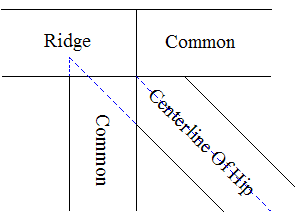
Intersection of hip and commons at end of ridge.
The reason they come up short is easy to see in the drawing of the intersection of the hip and the commons at the end of the ridge. If the hip were to be extended, additional length would need to be added to the common to make it meet the hip properly.
The difference in length from one hip jack to the next is the same based on the rafter spacing and the pitches of the two roof planes that intersect at the hip. To calculate the difference, first calculate a rafter length using the rafter spacing as run. If the pitches are the same on both sides of the hip this will be the difference in length between hip jacks. If the pitches are different, first divide this length by the pitch the hip jack is on then multiply by the pitch on the other side of the hip. This difference in length can then be subtracted from one hip jack to get the length of the next smaller one.
The difference in length between the common rafter length and the longest hip jack also depends on the thicknesses of both the rafters and the hip. An adjustment must be made to the length of the common rafter before using it to calculate the hip jack lengths. It is necessary to calculate the point where the hip and common would intersect to determine how much to adjust the common. The amount of adjustment will be different on each side of the hip if the pitches are not the same.
Formula For Calculating Allowance:
This formula will calculate the horizontal distance from the end of the common rafter to the point where it would intersect the hip. Use this distance to calculate a rafter length to be added to the length of the common rafter. The length calculated to add to the common may be a negative number if the hip is thicker than the rafters.
R = Rafter Thickness
H = Hip Thickness
P = Pitch of Roof
OP = Pitch of Roof on Opposite Side of Hip
SquareRoot = Square Root Function
Allowance = (R - (H / SquareRoot(P * P + OP * OP))* OP) / P * OP
For a roof using 1 1/2 inch thick material where the pitches are the same on both sides of the hip, approximately 7/16 inch should be added to the run for the common. The amount of adjustment will vary if the pitches are different on each side of the hip.
Note: Another factor that effects hip jack rafters is the proper cutting and placement of the hip. Care should be taken to ensure that the top of the hip is cut so both top edges of the hip plane with the common rafters on each side at the same time. If the pitches on each side are different, the hip must be shifted towards the smaller pitch side. Just as in the case where there are different pitches on each side of a ridge, the point where the two planes of the roof intersect is not in the center of the board.
