A split pitch span is one in which the rise is different for each side of the ridge.
To calculate the rafter for a given side of a split pitch span you must first calculate the run for that side of the ridge. This is easily done by dividing the span by the sum of the two pitches then multiplying by the pitch on the opposite side of the ridge. It is important to first subtract the thickness of the ridge. The rafter length can then be calculated from the run.
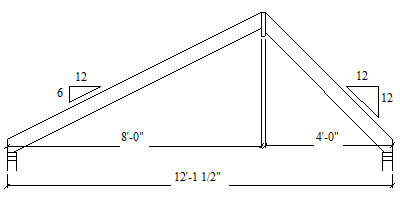
Example shows 6/12 on one side 12/12 on the other.
A split pitch span is one in which the rise is different for each side of the ridge.
To calculate the rafter for a given side of a split pitch span you must first calculate the run for that side of the ridge. This is easily done by dividing the span by the sum of the two pitches then multiplying by the pitch on the opposite side of the ridge. It is important to first subtract the thickness of the ridge. The rafter length can then be calculated from the run.
In the example, the building is 12'0" after allowing 1 1/2" for the ridge. 12'0" divided by 18 (the sum of the two pitches) times 12 = 8'0", the run for the 6:12 side. 12'0"divided by 18 times 6 = 4'0", the run for the 12:12 side.
When the wall heights are different, it is necessary to subtract from the building width to allow for the height difference, calculate the runs then add back to the run for the low side. Calculate the distance to add and subtract using the differance in height and the pitch for the lower wall. The height differance in inches divided by inches of rise per foot equals the number of feet to allow.
